
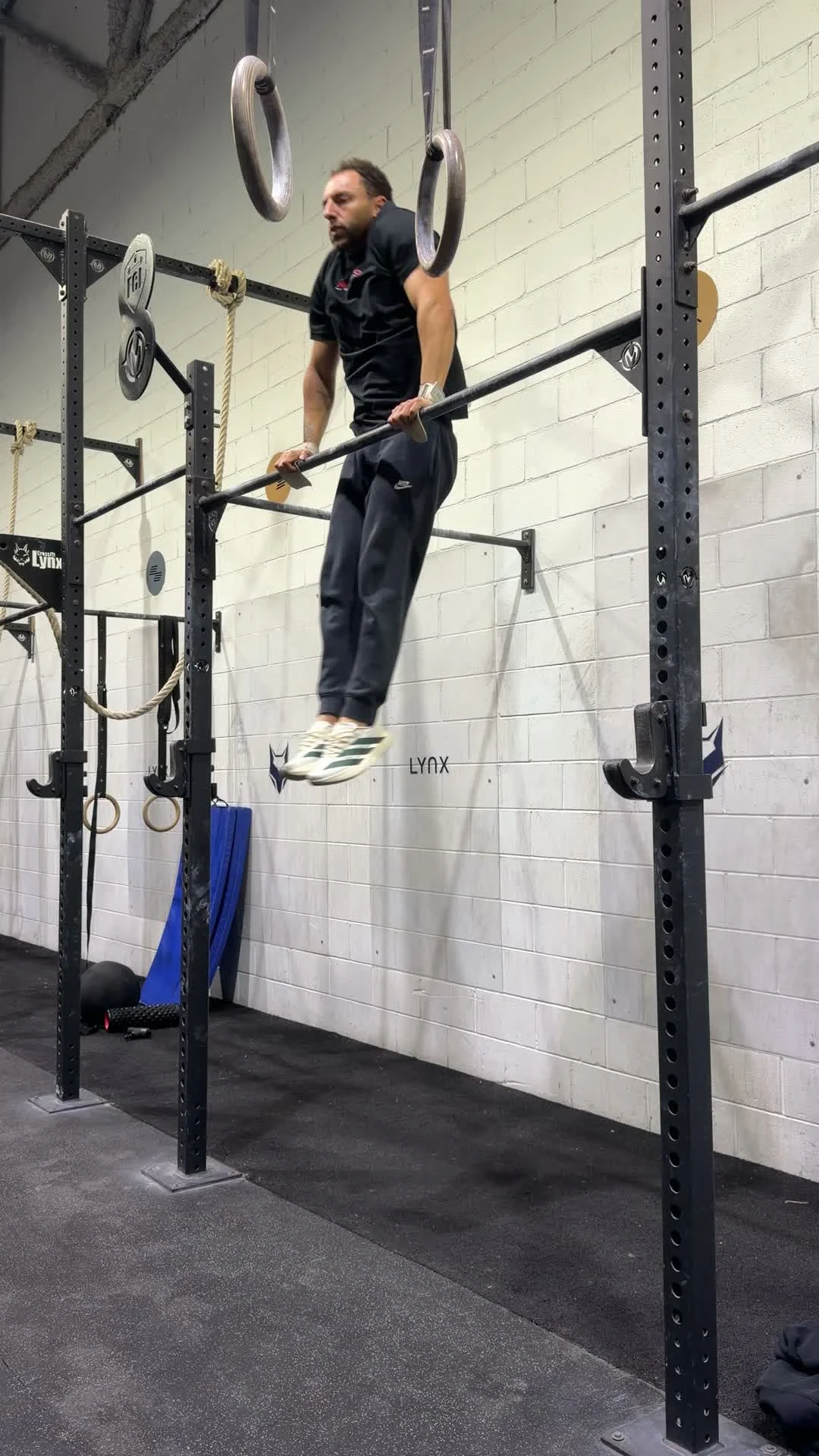
You stand under the bar, build a swing, pull and end up underneath it again. From the outside, it can look as though all you need is a harder pull. But the bar muscle-up is not simply a higher pull-up: it connects a swing, a pull, a transition and support above the bar. When one part is unclear, repeating the entire attempt can make it harder to understand what to practise.
You can turn that big goal into smaller questions. What can you already do? Which phase can you actually see? What task lets you work on it with your coach? The answers guide practice without pretending there is one identical route for everyone.
Understand where you are going
CrossFit describes the kipping bar muscle-up as a movement that starts in a hang and finishes in support with the arms extended, passing through parts of a pull and a press. The whole journey matters: getting on top is not just about height. You also need to organise the transition around the bar and the final support.
Watch a complete demonstration before concentrating on a still frame. Where does the athlete start? How do the swing and pull relate? When does the transition happen? How does the rep finish? You do not need to copy every angle yet; first understand the overall sequence.
Talk about your starting point
Your coach needs to know what you can do with control, which variations you know and what happens when you attempt the skill. Someone building their pulling and support foundations may need a different task from someone who already reaches height and is learning the transition.
Context matters too. An attempt after a demanding WOD, on a different bar or with half the body out of frame tells an incomplete story. Do not treat one fatigued attempt as a full assessment of your ability. If you have a limitation or discomfort, discuss it with an appropriate professional before continuing; this article cannot provide an individual assessment.
Separate the phases to learn
Swing. Look for a recognisable beginning and a rhythm you can maintain in the selected task. The goal is not to move as much as possible, but to control the pattern you are practising.
Pull. The question is not just how hard you pull, but how the pull relates to the movement before it. Ask your coach which phase is visible and which task fits your current level.
Transition. Moving from below the bar to above it deserves attention of its own. A low-bar progression with leg assistance appears in CrossFit’s official bar muscle-up plan. That does not make it the right task for everybody: choose and adapt it under supervision.
Support. The goal finishes above the bar, not when your shoulders first pass it. Work on the final position your coach considers appropriate for you.
One video, one question
Record your full body and the bar from an angle that shows the phase you want to review. Watch at normal speed and ask a specific question: “Can I distinguish the pull from the transition?” or “Do I reach a support position?” Avoid trying to apply ten corrections at once.
A comparable reference may help you notice a difference, but two athletes do not need to look identical. A single frame cannot diagnose an internal cause. Your coach may ask for another angle or decide the footage does not support a conclusion.
What about the ring muscle-up?
Both movements connect pulling, transition and support, but rings move, and grip and organisation differ. Do not assume a bar cue applies unchanged to rings. CrossFit’s rings and muscle-up guide shows grip, transition and an assisted option as distinct parts of the movement.
Plan the next practice
Choose a priority phase with your coach and a progression you can perform with control. Before you finish, agree what you will look for next time: a visible position, a sequence or a rhythm. Compare attempts made in similar conditions, and recognise that “we cannot see it clearly” is a useful answer.
YOUR NEXT STEP.
WITH A PLAN.
NQ Gymnastics is preparing an eight-skill programme with Eric Gallart, including bar and ring muscle-ups. Ask about the first edition, requirements, language and terms. Movement analysis and Phantom are in development; availability will be confirmed before purchase.
Explore the pack ↗Sources and context
An NQ editorial guide. It does not replace an individual assessment or a programme adapted by your coach. Course technical materials await Eric’s review.