
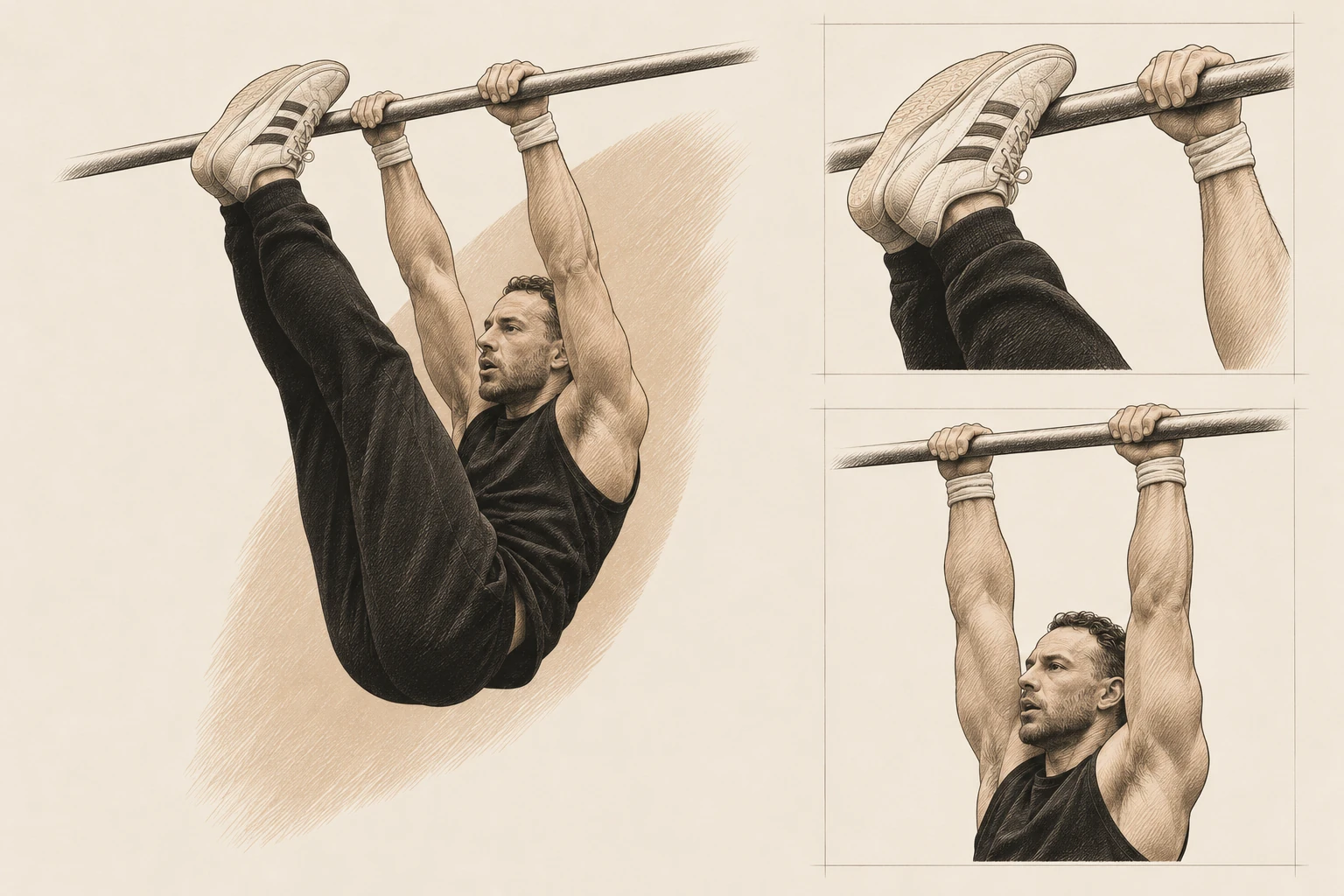
You get your feet to the bar, come down and suddenly the next rep feels miles away. You are swinging, but you are no longer sure when to start. Getting one repetition and linking several are related challenges, but they are not quite the same. First you need to reach the target; then you need to organise the return so you can begin again.
There is no single fix for every athlete. A complete recording and a conversation with your coach can help you tell the difference between a timing issue, a range you do not yet control and a task that is simply too demanding for your current starting point.
Look at the whole movement
A kipping toes-to-bar involves a swing, a lift of the feet and a return that sets up the next rep. If you only watch the moment your toes touch the bar, you miss what happens immediately before and after it. CrossFit’s toes-to-bar guide discusses the coordination of the swing and the role of the lowering phase in linking reps.
Start with three questions: can you recognise the swing before the lift? Do your feet reach the chosen target with control? What do your feet, chest and shoulders do on the way back? You do not need to answer all three during one set. Pick one and observe.
When rep one happens and rep two disappears
If your coach agrees that the angle will show the detail you need, film from the side with your whole body and the bar in frame. Watch once at normal speed: does the movement keep a recognisable rhythm? Then look at the return. Sometimes all the attention goes into the lift and the feet come back without a clear intention, leaving the athlete in a difficult position to start again.
That is one possible observation, not a diagnosis. A camera can hide details, and an image alone cannot explain your strength, mobility or the cause of a difficulty. If the relevant phase is unclear, record again or ask your coach before drawing a conclusion.
Change the task before adding reps
If the full range makes the rhythm disappear, a shorter range may let you practise a part you can control. CrossFit offers hanging knee raises as one way to adjust the complexity. Choose the actual task with your coach, considering your experience and what you want to improve.
You can also separate the swing from the lift. Practise the sequence your coach selects, then reintroduce the lift when you can keep the purpose of the task. A progression is not a race to tick boxes. What matters is what you can recognise and repeat with control.
If you already link a few reps, compare a short set with another later in the session. Does the same phase remain recognisable? Does the rhythm change? This may help you discuss how to divide the work in a WOD, without assuming one strategy fits every athlete or workout.
A useful way to work with video
A visual reference can help when the variation, angle and phase are comparable. Overlaying two different bodies does not automatically make every difference an error. A reference can guide the conversation; it does not replace a coach’s judgement.
- Agree with your coach on one detail to look for.
- Record an attempt with the bar and full movement visible.
- Review one phase: swing, lift or return.
- Practise the chosen progression and record another comparable attempt.
- Ask whether the intended change is visible. If it is not, the answer may be that you need another angle or more context.
From one movement to a plan
If toes-to-bar is only one of the skills you want to improve, think about the relationship between your work on the bar, rings and hands. A useful pathway does not demand that you master everything at once. It helps you understand the next step for each movement and why you are practising it.
YOUR NEXT STEP.
WITH A PLAN.
NQ Gymnastics is preparing a first edition with eight skills, teaching and progressions from Eric Gallart. Movement analysis and the Phantom reference are in development; their scope and availability will be confirmed before purchase. Ask about the pack and tell NQ where you are starting.
Explore the pack ↗Sources and context
An NQ editorial guide. It does not replace an individual assessment or a programme adapted by your coach. Course technical materials await Eric’s review.